

News
New GONOW Move Freely Live Fully
New GONOW Move Freely Live Fully
A towable RV — commonly called a caravan in Australia, the UK, and much of Europe — is a self-contained living unit designed to be hitched to and pulled by a separate tow vehicle. Unlike motorhomes, which integrate the engine and living quarters into a single unit, towable RVs offer a critical practical advantage: you can unhitch at your destination and use your tow vehicle independently.
Within the towable category, the market divides cleanly into two tribes: on-road caravans, engineered for sealed highways and established campgrounds, and off-road caravans, built to venture where the bitumen ends. Both will sleep, feed, and shelter you — but they are designed around entirely different philosophies of travel.
On-road caravans represent the mainstream of the industry. They are optimised for what most families and couples actually do most of the time: drive on sealed roads between towns, pull into powered campground sites, connect to mains electricity and town water, and live in genuine comfort for days or weeks at a stretch.
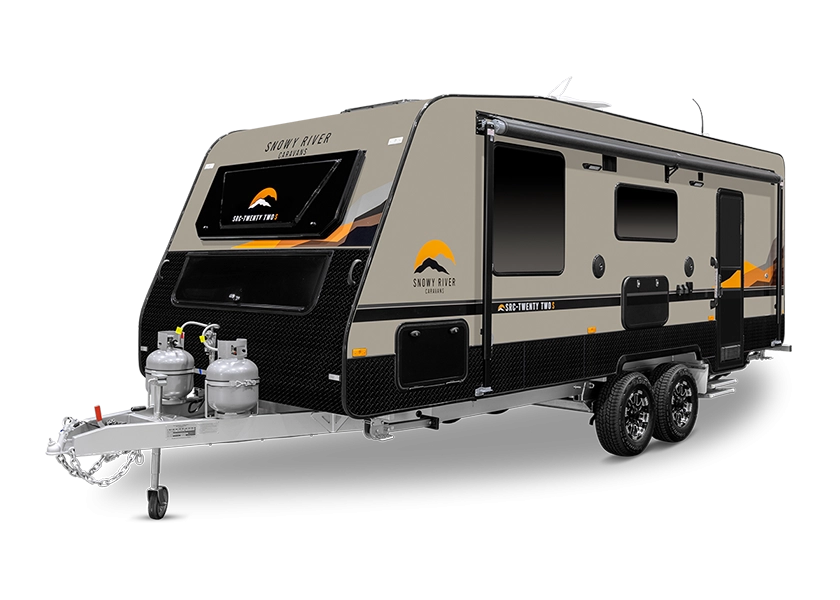
A modern on-road caravan is built on a steel chassis with a relatively low ride height — typically 300 to 400mm of ground clearance. The body is usually aluminium-framed with composite panel cladding, keeping overall weight manageable. A well-specified family van might weigh between 2,000 and 3,000 kg (Aggregate Trailer Mass), which sits within the towing capacity of most mid-size SUVs and large sedans.
Suspension is conventionally a leaf-spring axle setup, occasionally upgraded to independent coil systems on higher-end models. This is perfectly adequate for smooth road surfaces but will transmit punishment on corrugated dirt tracks — a critical limitation to understand before you drive off the edge of the map.
This is where on-road caravans shine. Manufacturers have decades of experience wringing impressive liveability from a fixed footprint, and the results can be genuinely luxurious. A mid-range 22-foot on-road van typically includes:
Premium models from manufacturers such as Jayco, Coromal, or New Age Caravans push these specifications considerably higher, with theatre seating, dishwashers, and residential-style cabinetry.
The core appeal of an on-road caravan is accessibility — in every sense. They are relatively affordable (entry-level models start around AU$40,000–$50,000; mid-range family vans sit between $70,000 and $120,000), can be towed by vehicles most people already own, and offer a standard of domestic comfort that makes week-long or month-long travel sustainable for the whole family. For grey nomads touring the Pacific Highway, families doing a lap of the country's east coast, or couples chasing the grape harvest from region to region, an on-road caravan is a highly logical choice.
Their weakness is equally clear: the moment the road surface deteriorates seriously, they become liabilities. Low clearance means grounding out on rocks or crests. Light-duty suspension transmits every corrugation into the structure, loosening joints and cracking cabinetry over time.
And their water and power self-sufficiency — while improving — rarely supports more than two or three days without a refill or hookup.
Off-road caravans — sometimes called "hard-floor camper trailers" at the lighter end and "off-road tourers" at the fully built-out end — exist to solve a fundamentally different problem. Their owners want to access places that no road-going vehicle, let alone a standard caravan, was ever meant to reach: national park fire tracks, remote station roads, beach access tracks across soft sand, and the kind of corrugated outback routes that shake ordinary equipment to pieces.
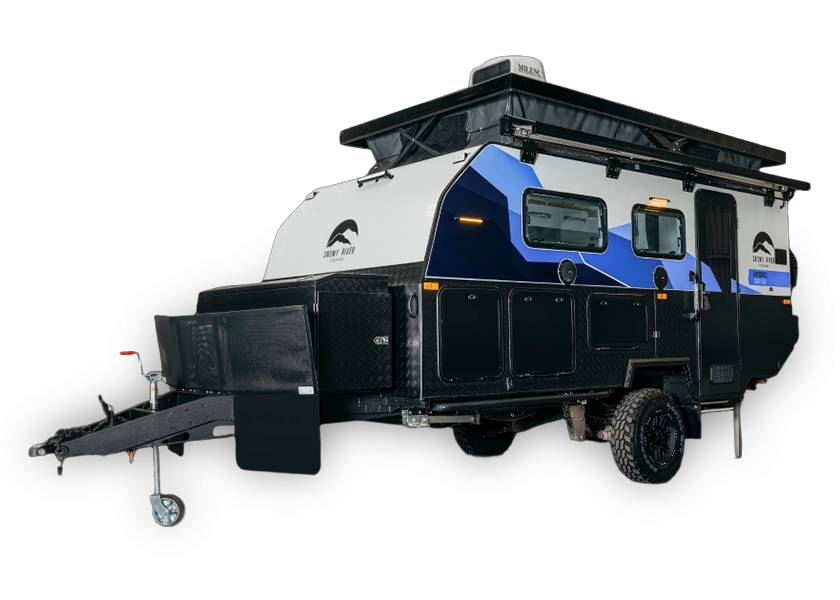
The engineering difference between an on-road and off-road caravan begins at the chassis. Off-road units are built on heavy-gauge steel box-section frames — often 100×50mm or larger — with full underbody protection plating to guard the tank and pipe runs from rock strike. Chassis thickness and welding quality are the first things a serious buyer inspects.
Ground clearance jumps dramatically, typically to 350–500mm or more, achieved through raised body mounting and larger-diameter wheels (16-inch all-terrain tyres are standard; 17-inch are common). The difference in approach angle and departure angle between an on-road and off-road van is substantial enough to matter on any serious track.
Suspension is where the most significant engineering investment occurs. Quality off-road vans use independent trailing arm suspension — often the AL-KO Enduro or Cruisemaster CT systems — which allows each wheel to articulate independently over uneven terrain rather than transmitting shock through a shared beam axle. At this level, the van can maintain tyre contact with the ground over rocks and ruts that would have a conventional caravan bouncing dangerously.
Coupling systems are upgraded accordingly. A DO35 or similar off-road coupling with a wide articulation range prevents the trailer from trying to snap itself free when the tow vehicle and van are at dramatically different angles — a genuine risk on steep, rutted descents.
The other defining characteristic of a serious off-road caravan is its ability to operate entirely independently of external services. In the outback or a remote wilderness area, there is no mains power, no town water tap, and no dump station for grey water. The caravan must carry everything it needs.
A well-specified off-road tourer will carry:
These systems, combined with 40–60 litres of diesel or LPG for cooking and hot water, give a well-equipped off-road van a genuine freedom radius of seven to fourteen days without resupply — enough to reach and explore some of the most remote corners of the continent.
Off-road caravans command a significant premium. Entry-level models from reputable manufacturers such as MDC Caravans or Tvan start at approximately AU$60,000–$80,000. Mid-tier tourers from Patriot Campers, Reconn R2, or Zone RV sit between $100,000 and $160,000. Fully specced units from boutique builders can exceed $200,000.
They also demand more from the tow vehicle. True off-road tracks generally require a four-wheel-drive tow vehicle with low-range capability, appropriate ground clearance, and a tow rating that comfortably exceeds the van's ATM — typically a Toyota LandCruiser 300 Series, Ford Ranger, or equivalent. Towing a 3,500kg off-road van with a soft-roader SUV is not just inadvisable; on many tracks it is genuinely dangerous.
Maintenance demands are higher. Off-road travel subjects every joint, fitting, and component to vibration and shock loads that accelerate wear. Serious off-road travellers inspect and re-torque chassis bolts, check suspension bushes, and monitor tyre condition on a schedule that would surprise a casual caravanner.
The honest answer depends on two questions that only you can answer: where do you actually want to go, and what do you already drive?
Your trips centre on established tourist routes, coastal drives, or national park campgrounds with facilities. If your tow vehicle is a mid-size SUV or wagon, if you travel with children who need reliable amenities, or if your budget sits below $100,000 and you want the best comfort per dollar, an on-road van will serve you extraordinarily well for ninety-five percent of Australian — or European, or North American — travel destinations.
The places on your bucket list don't appear on a standard tourist map. If you want to camp on a remote beach with no one else in sight, drive the Gibb River Road in the Kimberley or the Oodnadatta Track in South Australia, or spend a week in a national park backcountry zone, you need a van that can handle the journey and sustain you once you arrive.
There is also a hybrid or "soft off-road" van, which sits between the two categories. Models like the Jayco Expanda Off-Road or the Avida Birdsville series offer slightly raised suspension, all-terrain tyres, and expanded water and power capacity, without the price tag or complexity of a purpose-built off-road tourer. For travellers who occasionally venture onto unsealed roads but spend most of their time on the highway, this middle ground is often the most rational choice.


