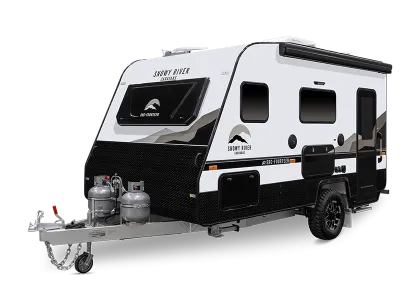
A caravan is a mobile living unit towed by a tow vehicle (typically a passenger van or SUV) and unhitched for use at the destination. In Europe, particularly the United Kingdom, it is one of the most popular forms of recreational travel and living.
Unlike self-propelled motorhomes, travel trailers lack their own propulsion systems. Structurally, they primarily feature aluminum alloy frames combined with GRP fiberglass or composite sandwich panels, balancing lightweight construction with thermal insulation. Interiors are typically divided into functional zones such as living/dining areas, kitchens, bathrooms, and bedrooms, with space optimized through compact designs like fold-out tables and built-in storage solutions.
In the UK, a standard Class B driver's license suffices for legal towing (subject to weight restrictions). Users often join organizations like the Caravan and Motorhome Club to access authorized campgrounds or privately certified sites (CL sites).
1. The difference is whether they have their own power systems. Motorhomes are vehicles with an integrated cab and living quarters, capable of driving on the road without being towed. Caravans, however, lack an engine and must be towed by another vehicle to move. Once it reaches its destination, it is unhitched and parked for use.
2. Motorhomes offer greater mobility and driving flexibility, making them ideal for travel involving frequent destination changes. However, once at a campsite, any excursion requires moving the entire vehicle, limiting convenience. Caravans, conversely, can be used independently after unhitching from the tow vehicle. Left at the campsite as a fixed base, they provide greater flexibility for daily outings.
3. Cost-wise, caravans typically have lower purchase prices than motorhomes for comparable living space and features, with relatively lower maintenance costs.
4. Regarding driving requirements, motorhomes' larger size demands experience for driving and parking. Heavier models (over 3.5 tons) may require additional licenses (e.g., C1 category) in some European countries. Caravans demand some towing skill, particularly for reverse parking maneuvers, though the towing vehicle itself has a lower driving threshold.
Overall, motorhomes emphasize convenience and an integrated experience, while caravans prioritize cost-effectiveness and preserve the flexibility of a daily driver.
In terms of usage scenarios, caravans can be mainly categorized into 2 types: on-road caravans and off-road caravans.
On-road caravans are main products on the market, specifically designed for traveling on paved roads and staying at formal campgrounds. Such travel trailers have minimal chassis clearance requirements and rely on campground infrastructure (water hookups, electrical hookups, and dump stations) for operation. Based on body specifications, they can be further categorized into single-axle and twin-axle models. The latter offers greater interior space and improved stability but demands higher towing capacity from the vehicle.
Off-road caravans are specifically engineered for unpaved terrain and wilderness environments, featuring structural and configuration differences that set them apart from their counterparts. They feature higher ground clearance, often employing independent suspension or off-road chassis (such as the Cruisemaster chassis), with reinforced body structures to withstand torsional stresses from rough terrain. Due to their remote operation away from campground infrastructure, these caravans typically include large-capacity lithium battery packs, solar panels, independent water tanks, and self-sufficient systems requiring no external hookups, and may even be fitted with off-road tires.
☛ On-Road Caravans ☛ Off-Road Caravans
A well-maintained caravan typically lasts 20 to 30 years, with some older models in excellent condition continuing to serve beyond this lifespan. Routine maintenance is paramount, and annual inspections are recommended. Its longevity depends less on age and more on the maintenance standards upheld by owners.

NEW GONOW was founded in 2003 and has since grown into one of China's most dedicated recreational vehicle specialists. Since refocusing on the RV sector in 2016, the Group has earned recognition as one of China's "Top Ten RV Brands" and "Australia's Best RV Model," demonstrating that its products are validated against some of the world's most demanding outdoor conditions.
Its manufacturing strength is backed by advanced production bases across China and a Smart Manufacturing Base in Melbourne, Australia, complemented by partnerships with Shanghai Jiao Tong University, RWTH Aachen University, and German motorhome specialist Hobby Motorhomes — ensuring access to world-class technology and design expertise. Guided by the mission of "Building Quality Vehicles for Our Families," NEW GONOW represents a trustworthy choice for buyers seeking internationally benchmarked quality with genuine RV expertise behind it.